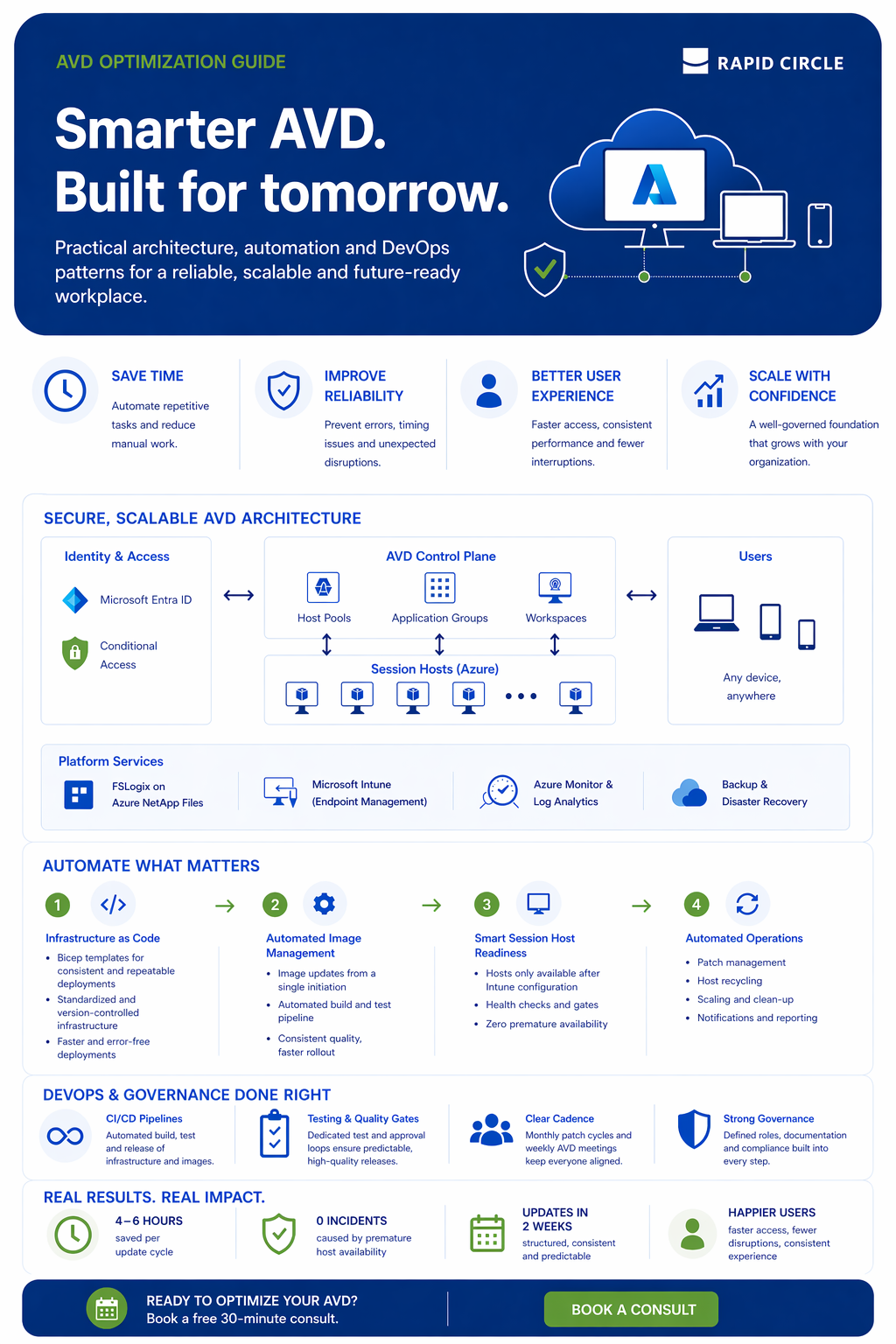
How challenging the status quo unlocked a new operating model for AVD.
A large public-servicing organization with roughly 1.000 Azure Virtual Desktop users – across two AVD environments, including GPU-enabled workloads – had already successfully modernized it’s digital workplace. The platform was live, the foundations were robust, and users were productive.
Yet the day-to-day operating reality revealed an important truth: a technically working AVD environment is not the same as an operationally predictable one. Manual processes, timing sensitive deployments and loosely structured DevOps pipelines created friction beneath the surface.
This wasn’t a sign of a failing platform, it was a sign of an environment ready for its next stage of maturity. And instead of simply maintaining it, Rapid Circle chose to challenge the operating model and redesign it for predictability, automation and scale.
From manual operations to a predictable AVD operating model
During the first weeks, a few patterns became clear. Consultants spent unnecessary time on repetitive tasks. Session hosts sometimes became available before Intune had finished its configuration. And processes for testing and communication varied between teams.
Rather than accepting these as “the way things are”, we reframed the situation:
What if the problem isn’t the environment, but the amount of human intervention it requires?
That shift in perspective unlocked the direction for transformation.
A strategic approach combining automation, DevOps maturity and improved governance
The new operating model centered around three pillars:
1. Automation where it delivers the highest return
By rebuilding pipelines, redesigning Bicep templates and automating recurring tasks, we created:
- Image updates that run automatically from a single initiation
- Session hosts that only become available after Intune completes configuration
The result: fewer manual decisions, fewer timing errors, more predictable outcomes.
2. A structured rhythm that brings control
We introduced a clear cadence to platform operations. Monthly patch cycles now include dedicated testing and approval loops. Weekly AVD coordination meetings align stakeholders and reduce noise around changes.
This cadence didn’t just improve governance, it removed uncertainty.
3. Platform improvements that strenghten reliability
FSLogix profiles were migrated to Azure NetApp Files for higher performance. DevOps pipelines were cleaned up and improved dependencies. Guidance became clearer; decision-making became faster.
Together, these measures shifted the environment from “operationally acceptable” to “operationally predictable”.
Measurable results after 6 months
The improvements became quickly visible.
Consultants now save between four and six hours per update cycle, time previously absorbed by manual deployment coordination. Incidents caused by premature host availability fell to zero. Updates that previously required around two weeks – including a full acceptance test window – are now fully structured, predictable and consistent.
For end users, the impact is simple and powerful:
✔ Faster access
✔ Fewer disruptions
✔ A desktop that behaves the same way everyday
For end users, the AVD environment has become something they no longer need to think about: a reliable, consistent workspace that supports productivity instead of interrupting it.
“It isn’t about working harder; it’s about not doing the same thing twice. If a task can be automated, it should be – because life is too short for manual repetition.”
– Donovan Botes, Consultant Rapid Circle
A future-proof AVD roadmap
This transformation is not the finish line. This transformation establishes the groundwork for how the workplace will evolve the coming years. With a predictable, automated and well‑governed baseline in place, the organization can now move toward a self‑optimizing AVD environment.
Several enhancements are already in motion. Automated session host recycling will maintain consistent performance across the lifecycle of each host. Dynamic scaling will ensure capacity adjusts automatically based on real‑time demand. An AVD Troubleshooting AI assistant will guide users instantly through common issues and generate standardized tickets, easing the pressure on the service desk.
Customer‑specific documentation will become part of the support workflow, enabling faster and more consistent resolutions. Monitoring dashboards will continue to evolve to provide clearer insights and earlier signals for improvement.
Step by step, these developments move the environment toward an AVD platform that not only runs reliably, but actively improves itself as the organization grows.
Unlock the full potential of your AVD environment
If your AVD environment still relies on manual steps, timing‑sensitive deployments or inconsistent processes, you might be closer to stability and automation than you think.
Ready for a tailor conversation? Book a free 30-minute AVD Automation Consultation and get a focused session with one of our experts to map improvement opportunities directly to your environment.
This isn’t about working harder, it’s about designing a workplace that works predictably, consistently and with far less effort.
Prefer to explore first? Download our AVD Optimization Guide to get a clear, practical overview of the architecture, automation and DevOps patterns behind a predictable AVD environment.


 English (Australia)
 Nederlands